

The Paradigm Shift in Class 10 Mathematics: Analyzing the NCERT New Pattern for AY 2026-27 | Concept of Maths
CBSE Class 10 Maths 2026–27 shifts to 50% competency-based questions. See pattern, marking scheme, and real impact on students.
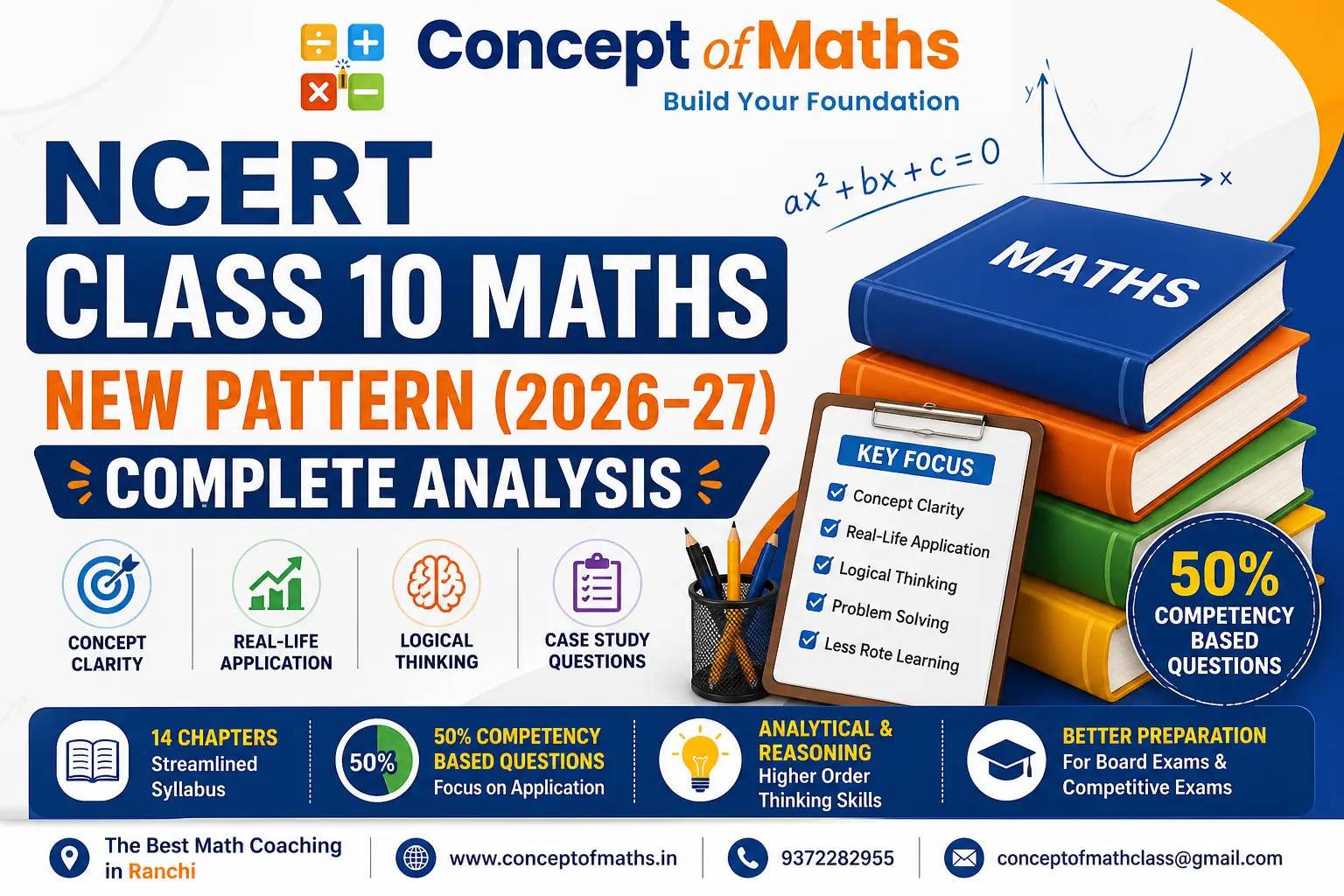
The Paradigm Shift in Class 10 Mathematics: Analyzing the NCERT New Pattern for AY 2026-27
The academic year 2026-27 stands as a landmark in the history of Indian secondary education. As the National Education Policy (NEP) 2020 and the National Curriculum Framework for School Education (NCF-SE) 2023 move into full-scale implementation, Class 10 Mathematics is undergoing a fundamental metamorphosis. While the structural rollout of new textbooks (like the Ganita Manjari series for Class 9) is planned for Class 10 in the subsequent 2027-28 session, the current 2026-27 cycle introduces a revolutionary Competency-Based Assessment model within the existing 14-chapter framework. This shift moves the goalpost from "knowing" mathematics to "doing" mathematics, demanding a higher degree of conceptual clarity and analytical rigor from students.
Curricular Continuity vs. Pedagogical Evolution
For the AY 2026-27, the Central Board of Secondary Education (CBSE) has maintained the core content of 14 chapters, yet the application of these chapters has been redesigned. The curriculum now prioritizes mathematical modeling, computational thinking, and data analytics over mere procedural fluency.
Key Content Pillars and Strategic Focus
The syllabus remains structured around seven major units, but the internal weightage and the type of problems posed have shifted toward higher-order thinking skills (HOTS).
| Unit No. | Unit Name | Marks Weightage | Key Concepts & Evolutionary Focus |
| I | Number Systems | 06 | Proofs of irrationality ($\sqrt{2}, \sqrt{3}, \sqrt{5}$) and Fundamental Theorem of Arithmetic. |
| II | Algebra | 20 | Focus on situational problems in Quadratic Equations and Arithmetic Progressions (AP). |
| III | Coordinate Geometry | 06 | Application of distance and section formulas in real-world mapping scenarios. |
| IV | Geometry | 15 | Emphasis on similarity criteria and circle tangents through logical proofs. |
| V | Trigonometry | 12 | Heights and distances involving two right triangles; real-life navigation problems. |
| VI | Mensuration | 10 | Surface areas/volumes of combined solids; interpreting complex industrial shapes. |
| VII | Statistics & Probability | 11 | Interpretation of grouped data (Mean, Median, Mode) and classical probability in uncertainty. |
The 50% Competency Pivot: A Structural Redesign
The most significant "difference" in the 2026-27 pattern is the standardization of competency-based questions (CBQs). For the first time, exactly 50% of the theory paper (40 out of 80 marks) is dedicated to questions that test the application of knowledge in unfamiliar or real-world contexts.
Breakdown of the 2026-27 Question Paper Design
| Section | Question Type | Marks Weightage | Focus Area |
| Section A | 20 MCQs (incl. Assertion-Reason) | 20% (20 Marks) | Conceptual breadth and logical cause-and-effect. |
| Section B/C | Short Answer (2 & 3 Marks) | 30% (28 Marks) | Procedural accuracy and step-wise reasoning. |
| Section D | Long Answer (5 Marks) | 25% (20 Marks) | Complex problem solving and theoretical proofs. |
| Section E | Case-Study Questions | 25% (12 Marks) | Contextualizing NCERT concepts in real-world stories. |
Why the Change? Addressing "Learning Poverty"
The transition was necessitated by the realization that traditional patterns often rewarded rote memorization. Students could score high marks by memorizing steps without understanding the underlying "why". The 2026-27 pattern aims to:
- Bridge the Application Gap: Mathematics is no longer taught in isolation but is integrated with Indian Knowledge Systems (IKS), highlighting historical contributions of mathematicians like Brahmagupta and Bhaskaracharya to foster cultural pride.
- Foster Rationality: By forcing students to navigate situational problems, the curriculum builds the "disciplined way of thinking" required for democratic and economic participation.
- Global Alignment: The focus on mathematical communication and modeling aligns Indian students with international standards, preparing them for a globalized workforce.
Benefits for the 2027 Board Aspirants
Students entering Class 10 in 2026-27 will benefit from a more holistic development framework.
- Reduced Anxiety: The shift toward a Mastery-Based Learning approach encourages students to focus on understanding rather than just final results.
- Competitive Edge: The emphasis on application-driven MCQs and case studies provides a natural foundation for competitive exams like JEE and NEET, which follow similar analytical patterns.
- Flexible Assessment: With the introduction of Standard (041) and Basic (241) Mathematics, students can choose a level of difficulty that aligns with their future career goals—whether they pursue higher STEM education or other fields.
Implementation in Ranchi: A Local Perspective
In the educational hub of Ranchi, the shift has triggered a localized surge in demand for quality mentorship. Schools across Jharkhand are adopting math and science clubs to foster STEM skills, but the transition to 50% competency-based testing remains a challenge for many. Traditional "rote-drill" coaching is being replaced by institutions that emphasize logic and the "visual side" of geometry and algebra.
Navigating this complex landscape requires more than just standard tutoring; it demands a deep-rooted Concept of Maths that can withstand the rigors of the new NCF-SE 2023 framework. For students in Jharkhand seeking to master these new application-based challenges, finding the Best math coaching in Ranchi is crucial. Institutions like Concept of Maths are at the forefront of this pedagogical revolution, ensuring that every student develops the analytical reasoning and conceptual clarity needed to excel in the AY 2026-27 board examinations and beyond.
Discussion 0
Enjoyed this content?
Share your rating and feedback with us. It takes less than a minute!