

Mastering the Shift: A Comprehensive Guide to the Class 10 Science CBSE New Pattern for AY 2026-27 | Concept of Maths
Forget rote learning. The 2026-27 CBSE Science pattern brings 50% competency questions and two board exams. Master the shift with our guide to new NCERT style.
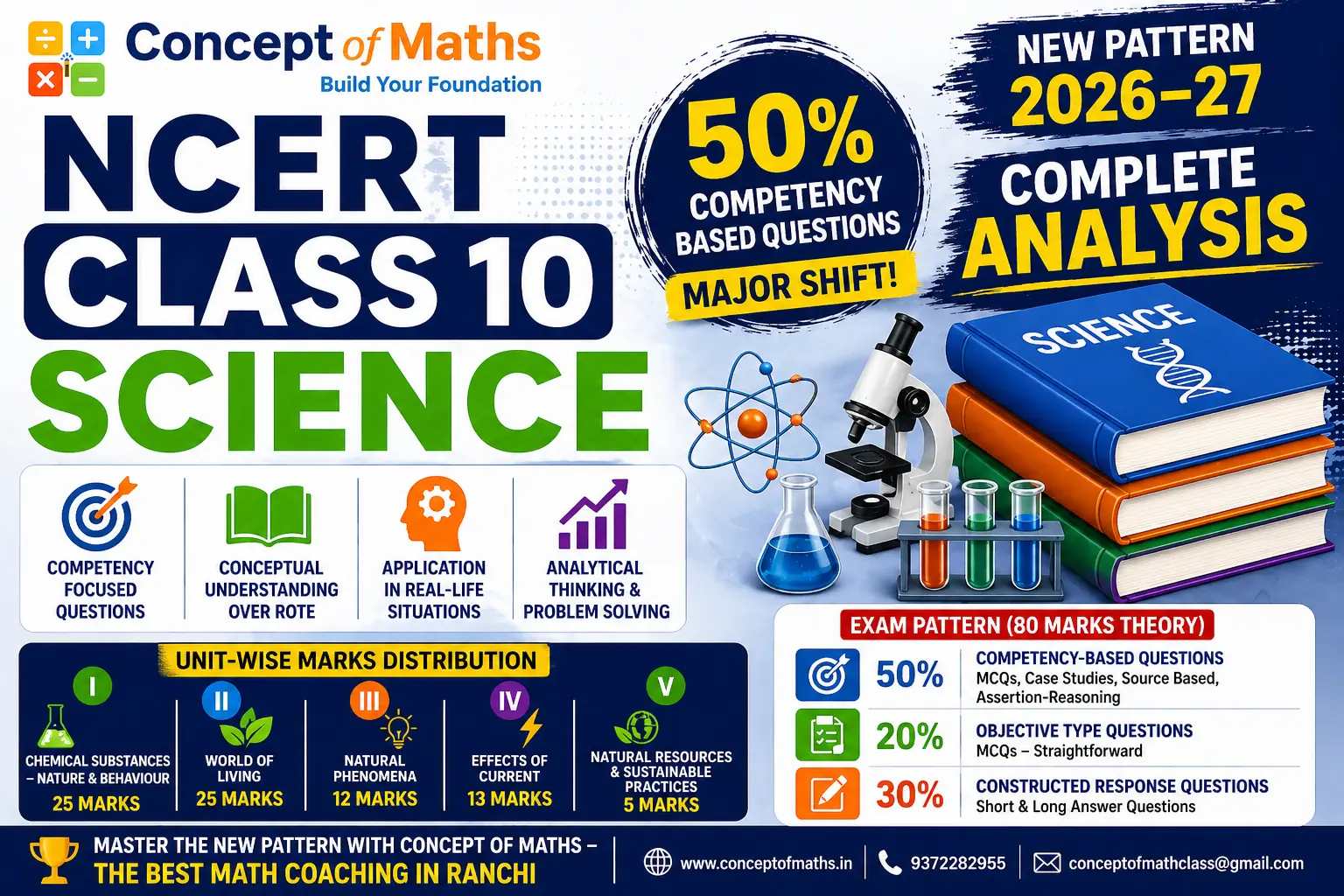
The days of memorizing an entire textbook and spitting it back out on an answer sheet are officially over. For students stepping into Class 10 for the Academic Year 2026-27, the landscape of CBSE Science has undergone a fundamental metamorphosis. This isn't just about a few deleted paragraphs; it is a total pivot in how the Indian education system defines "intelligence." Guided by the National Education Policy (NEP) 2020 and the NCF-SE 2023, the focus has shifted from rote learning to competency-based education.
The Blueprint: What’s Actually Changing?
While the brand-new textbooks for Class 10 (following the Class 9 Curiosity and Ganita Manjari series) are slated for a full rollout in 2027-28, the 2026-27 session serves as the critical transition year. Students will continue using the Rationalized NCERT textbooks, but the Board Exam 2027 will be the first to fully implement the 50% Competency-Based Question (CBQ) mandate.
What this means in plain English: exactly half of your 80-mark theory paper will now consist of case studies, assertion-reasoning, and data-interpretation questions. You can no longer "guess" the paper by solving the last ten years of questions because the board is now testing critical thinking over memory recall.
Chapter-Wise Reality Check: The "Less is More" Strategy
The NCERT has surgically removed nearly 30% of the content to reduce the cognitive load on students. Here is how the subjects have been streamlined:
- Chemistry: The biggest shock was the total removal of Periodic Classification of Elements. While it seems radical, the logic is sound: why force 15-year-olds to memorize historical classification attempts when they can focus deeper on Carbon Compounds and Chemical Bonding—the real bread and butter of higher science?
- Biology: The chapter "Heredity and Evolution" has been renamed simply to Heredity. All topics related to Darwinism, speciation, and human evolution have been moved out. The goal here is to master the concrete mechanisms of Mendelian inheritance and Life Processes before jumping into the abstract scales of evolutionary time.
- Physics: Gone are the descriptive "fluff" topics, such as why the sun looks red at sunset. Instead, the focus is now on mathematical precision. You are expected to master Lens and Mirror Formulas and Electricity numericals (like Ohm's Law and Power) because these form the backbone of the JEE and NEET foundations.
Statistical Snapshot of the 2026-27 Pattern
| Assessment Feature | Previous Pattern (Pre-2024) | New 2026-27 Pattern | ||
| Competency Questions | 20% - 30% | Exactly 50% | ||
| Objective MCQs | Limited | 20% (Logic-driven) | ||
| Theory/Descriptive | 50% - 60% | Reduced to 30% | ||
| Exam Opportunities | One High-Stakes Day | Two Board Windows | ||
| Internal Assessment | Basic Practicals | 20 Marks (Portfolio + Skills) |
The "Best of Two" Safety Net
Perhaps the most human-centric change is the introduction of the Two-Window Board Examination system. Starting in 2026, Class 10 students can take their board exams twice—once in February-March and again in May-June. If you have a bad day during the first attempt, or simply want to improve your score in Science or Maths, you can sit for the second phase and the board will carry forward your "Best-of-Two" scores. This effectively ends the era of "one exam deciding your life," significantly reducing student anxiety.
Why This is a "Win" for the Modern Student
The old system produced students who were "literate but not functional." The new pattern forces a conceptual understanding that prepares you for the real world.
- Competitive Advantage: Since JEE and NEET are already application-based, training for a 50% competency board exam gives you a natural head start.
- Skill-Based Learning: The integration of Vocational Education and Computational Thinking means students are learning job-ready skills like coding and data handling alongside their regular science experiments.
Regional Pulse: Implementing the Change in Ranchi
The impact of these reforms is already visible on the ground in Ranchi. The Jharkhand Education Project Council (JEPC) has launched math and science clubs in 173 government schools across the district to support this new "activity-based" learning style. However, recent data shows a regional "readiness gap." While national pass rates are high, Ranchi recently saw a compartment rate of 10.30%, largely because students used to "straight questions" struggled with the new "bent" competency-based ones.
This trend proves that standard rote-style coaching is no longer enough. To survive the 2027 boards, students must move away from memorizing formulas and start building a deep Concept of Maths and Science. Whether you are navigating the complexities of electrical circuits or algebraic identities, the ability to apply logic is the only way to score high. For those looking to master this new landscape, finding the best coaching institute is essential to bridge the gap between textbook theory and board-level application. Let me know if you need any other class-specific breakdowns!
Discussion 0
Enjoyed this content?
Share your rating and feedback with us. It takes less than a minute!