

Master Algebra: A Step-by-Step Guide to Solving Equations | Concept of Maths
Learn how to solve any math equation with this easy step-by-step guide. From basic linear equations to complex quadratics, master algebra the simple way!
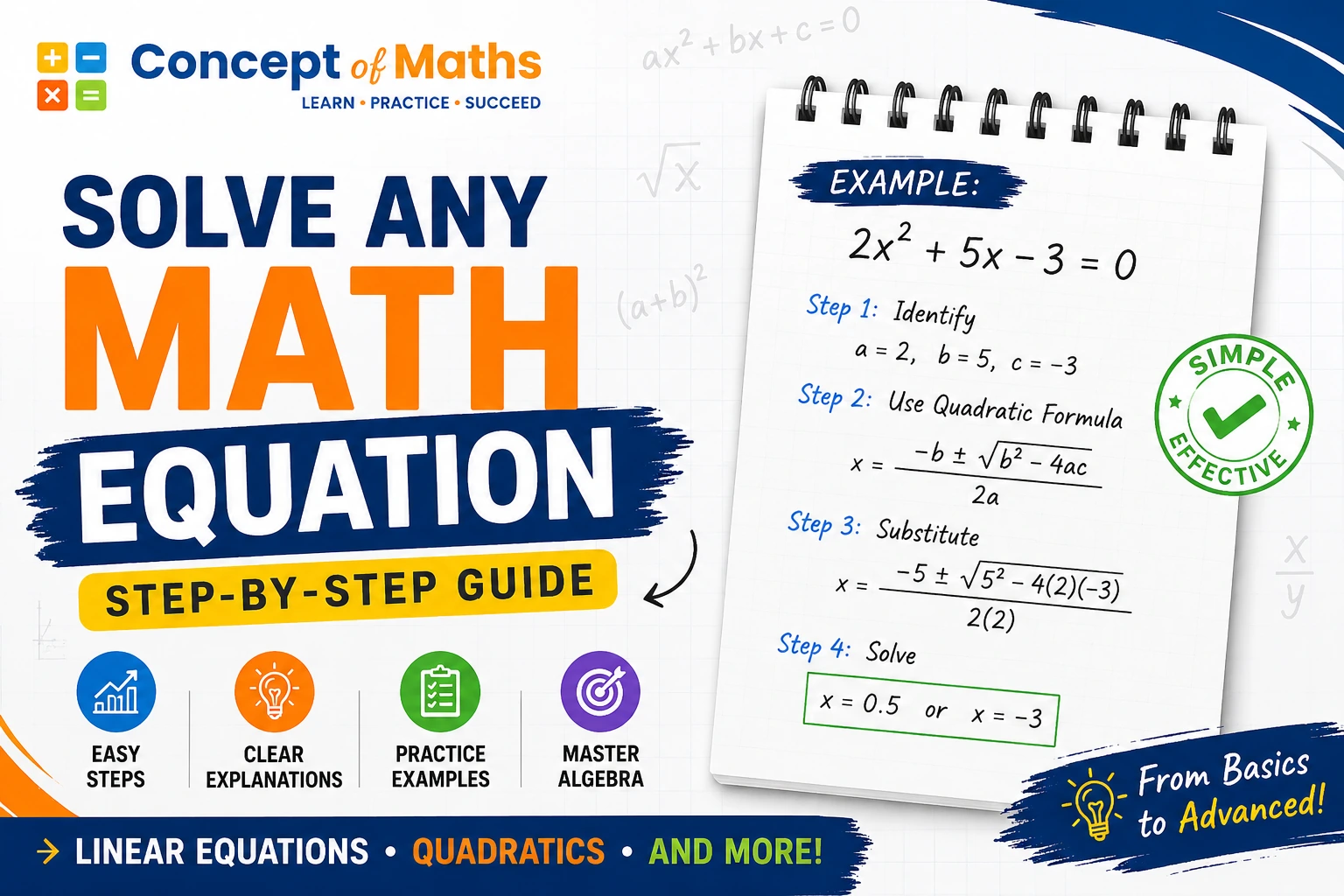
How to Solve Algebraic Equations: A Basic Algebra Step-by-Step Guide
Have you ever looked at a math equation and felt like you were trying to read a foreign language? You are definitely not alone.
But here is a secret that your math teachers might not have explicitly shared: Every single algebra equation is just a perfectly balanced seesaw.
Imagine a playground seesaw that is perfectly level. If you add a 5-pound weight to the left side, the seesaw tips. To make it level again, you absolutely must add a 5-pound weight to the right side. That is the one and only golden rule for understanding algebraic formulas: Whatever you do to one side of the equals sign, you must do the exact same thing to the other side.
Once you understand how to balance math equations, solving for 'x' stops being a chore and starts becoming a game. Let me show you how to play it, starting from the basics and working our way up to the boss levels.
Level 1: The Basics (Solving Linear Equations)
Let’s start with a warm-up equation:
x + 9 = 20
Step 1: Identify your goal.
You want the letter 'x' to be completely alone on one side of the equals sign. Right now, it has a pesky "+ 9" hanging out with it.
Step 2: Do the opposite.
To get rid of that "+ 9", we need to do the exact opposite mathematical operation. The opposite of adding 9 is subtracting 9.
Step 3: Balance the scale.
If we subtract 9 from the left side, the rule says we must subtract 9 from the right side to keep our seesaw level.
- Left side: x + 9 - 9 (The 9s cancel out, leaving just x)
- Right side: 20 - 9 = 11
Final Answer:
x = 11
Teacher's Tip: Always check your work! Plug 11 back into the original equation. Does 11 + 9 = 20? Yes! The scale is balanced.
Level 2: Turning Up the Heat (Complex Linear Equations)
Now let’s look at something that looks a bit more intimidating. What happens when you have variables and numbers on both sides?
4x - 7 = 2x + 9
Don't panic. We are just going to use our step-by-step math solver mindset to move things around until all the 'x's are on one side, and all the regular numbers are on the other.
Step 1: Move the smaller 'x'.
We have 4x on the left and 2x on the right. It is usually easier to move the smaller one. Let's get rid of the 2x on the right by subtracting 2x.
Rule Check: If we subtract 2x from the right, we must subtract 2x from the left!
- (4x - 2x) - 7 = (2x - 2x) + 9
- 2x - 7 = 9
Look at that! It already looks much cleaner.
Step 2: Isolate the 'x' term.
Now we need to get rid of that "- 7" on the left side. The opposite of subtracting 7 is adding 7. Let's add 7 to both sides to keep the balance.
- 2x - 7 + 7 = 9 + 7
- 2x = 16
Step 3: Free the 'x'.
"2x" just means "2 multiplied by x". To undo multiplication, we divide. Let's divide both sides by 2.
- (2x) / 2 = 16 / 2
- x = 8
Boom. You just solved a multi-step equation by simply keeping the scale balanced.
Level 3: The Boss Fight (Solve Quadratic Equations by Factoring)
Let’s raise the bar one last time. What if your 'x' has an exponent? Welcome to quadratic equations.
$$x^2 - 5x + 6 = 0$$
Because of that $x^2$, we usually end up with two correct answers instead of one. We can't just move things side-to-side here. Instead, we use a clever mathematical technique called factorization.
Step 1: Break it into pieces.
Our goal is to rewrite this equation as two sets of parentheses multiplying together to equal zero:
$(x \pm ?) (x \pm ?) = 0$
Step 2: The Number Puzzle.
To fill in those question marks, we need to find two magic numbers. These two numbers must:
- Multiply to give us the last number (+6).
- Add together to give us the middle number (-5).
Let's think about factors of 6:
- 2 and 3? (2 * 3 = 6, but 2 + 3 = 5. We need negative 5!)
- -2 and -3? (-2 * -3 = +6, and -2 + -3 = -5. We found them!)
So, we rewrite our equation:
$$(x - 2)(x - 3) = 0$$
Step 3: The Zero-Product Property (A Fancy Rule for a Simple Idea).
Think about this: If I tell you that I am multiplying two numbers together and the answer is zero, what do you know for sure? At least one of those numbers has to be zero.
So, either the first group equals zero, or the second group equals zero. We split them up into two tiny equations:
- x - 2 = 0
- x - 3 = 0
Step 4: Solve the mini-equations.
Use your balance rules!
- Add 2 to both sides: x = 2
- Add 3 to both sides: x = 3
You did it! The solutions are 2 and 3.
Math Doesn't Have to be a Mystery
Whether it is a basic addition problem or a complex quadratic puzzle, the fundamental rule of balance never changes. Once you grasp the "why" behind the steps, the "how" becomes second nature.
If you found this breakdown helpful and are looking for a dedicated maths coaching service to help you master these concepts without the anxiety, come visit us over at conceptofmaths.in. We specialize in breaking down tough mathematical formulas into bite-sized, logical lessons that actually make sense. Stop memorizing and start truly understanding the logic today!
Discussion 0
Enjoyed this content?
Share your rating and feedback with us. It takes less than a minute!